Tobi Lutke
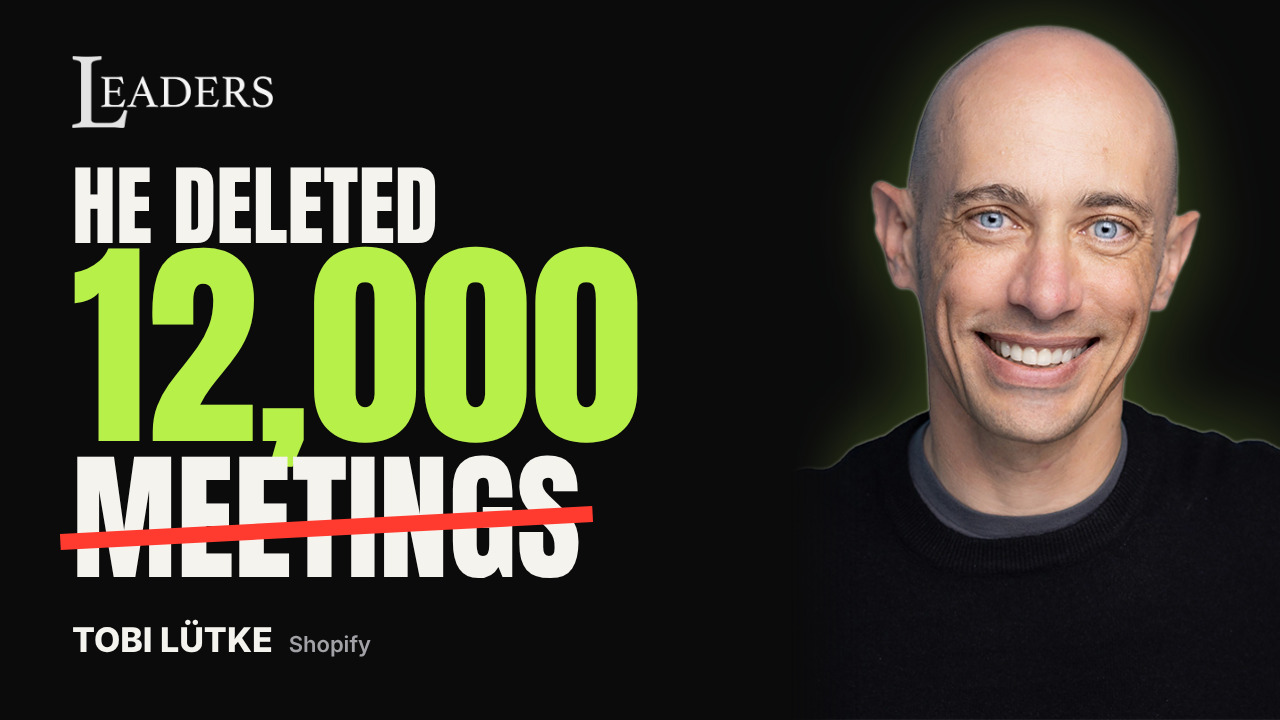
Tobi Lütke didn’t believe in leadership. For years, the Shopify founder thought that if you pointed talented people in the right direction, good results would follow. He later said he’d been completely wrong about that.
This episode looks at how Tobi leads through three pairs of ideas that seem to contradict each other:
The Trust Battery vs. the Tobi Tornado. Trust between colleagues starts at 50%, fills slowly through reliable behavior, and drains fast when people let each other down. On projects, though, Tobi is quick and ruthless: he shuts down ones that aren’t working.
A team, not a family. His 2021 memo called the idea of a company as a family “preposterous” and said everyone has to re-qualify for their job every year. It also has an idealistic side: his belief in getting the most out of people’s potential.
100-year thinking vs. fast, sweeping memos. He plans decades ahead and optimizes for a customer’s lifetime value, not the single sale. He also changes how the whole company works with one memo. The clearest example is his 2025 AI memo: before asking for more headcount, teams must show why AI can’t do the work.
We read both memos in full, then close with the mental models behind how he operates: Crocker’s rules, systems thinking, and running a business like an engineer.
Chapters
0:00 Three tensions in how Tobi leads
1:30 The CEO who didn’t believe in leadership
2:26 The Trust Battery vs. the Tobi Tornado
3:37 A team, not a family
4:38 Reading the 2021 leadership memo
11:17 Why the memo works
13:45 100-year thinking and infinite games
14:44 The 2025 AI memo
23:38 Tobi’s mental models
24:35 Closing
#Leadership #Shopify #TobiLutke #Founders #AI

 Spotify

 Apple Podcasts

 YouTube

 Castro

 RSS Feed
Episode 58: Tobi Lütke: Building with Purpose, Thinking Differently, and Leading Through Innovation
What does it take to build a company that reshapes an entire industry while staying true to a vision? And how do you create a culture that encourages people to challenge convention, take ownership, and think independently?
In this episode, we explore the leadership philosophy of Tobi Lütke, co-founder and CEO of Shopify, and the principles behind building one of the world's leading commerce platforms.
From embracing a founder's mindset and making bold decisions to fostering a culture of continuous learning and innovation, Lütke offers a fresh perspective on what it takes to lead in an increasingly complex business environment. We explore the importance of intellectual curiosity, adaptability, empowering people, and maintaining a long-term perspective when navigating uncertainty.
Whether you're an established executive, an emerging leader, or an entrepreneur, this conversation offers valuable insights into building resilient organizations, challenging the status quo, and creating the conditions for people and businesses to thrive.
Listen in and discover what leaders can learn from Tobi Lütke about thinking differently, building for the long term, and leading through change.
Leaders — Episode 58: Tobi Lütke: The CEO Who Didn't Believe in Leadership
Source: https://www.youtube.com/watch?v=b83qdKtcihQ (YouTube auto-generated captions)
[0:01] On today's episode, we'll open with an interesting concept here of the subject of this podcast, episode 58, really didn't believe in leadership and how that was reversed over time based on his thoughts and reflection. For this episode, we're going to build around three different tensions that actually contradict each other in useful ways to tell more about episode 58 subject Tobi Lütke. One of those being a trust battery, that being patient or relational versus the quote unquote Tobi tornado, which is being ruthless and fast. The second dynamic being a team, not a family. So more hard edged versus maximizing human potential as idealistic. And finally, the third tension from this leadership standpoint that we'll build on is a 100-year thinking process versus a memo that reorganized 8,000 people in his company in one week.
[1:11] We'll finally close on a topic that is top of mind for many companies today, but an AI memo that was the current test of whether his operating system held. Sourcing every act to his own words makes it feel like a portrait rather than a profile. Welcome back to Leaders, a podcast dedicated to exploring the best leaders this world has ever seen and your number one source for actionable business leadership insights. Tobi Lütke, CEO of Shopify, one of the most successful e-commerce brands. And certainly Tobi is a leader that should be studied. And really, Tobi admits he flatly didn't believe ma leadership mattered in his former life, thinking that good individuals pointed in a direction would produce the right outcomes. He now kind of admits that that was utterly incorrect. A CEO kind of publicly reversing himself on whether leadership exists uh is a strong kind of self-awareness in his right and a strong opening here for us to build upon.
[2:26] Let's first go into that first tension trust battery. So how that is framed and how he's described that is instead of treating trust between colleagues as fixed by uh title or tenure. He uses the metaphor of a battery that charges through consistent reliable behavior and depletes when people let each other down. It's more of a systems model applied to something usually treated as soft or immeasurable. Trust as a stock that responds to inputs and outputs over time. It sort of starts with a new colleague at 50%, charges or drains with each interaction, and is slow to fill but fast to empty. Shopify really found it a useful way to surface trust and reviews without it feeling personal. Contrast that with the Tobi tornado. He likes to kill projects fast when they aren't working. Part of the tight packaging of his operating philosophy alongside his first principles thinking is that decision m decision-making as collaborative but explicitly not democratic and reasoning backward from a 100-year vision which we'll build upon.
[3:37] The second tension is team not family being very hard-edged versus maximizing human potential or being idealistic. There is a uh 2021 during the COVID era. He put out an email that was basically saying we're not a family and that's a necessary counterweight. He called the family framing preposterous, warning that family thinking makes it incredibly hard to let poor performers go and said Shopify is a team, not a family. It landed amid real internal tension over the company's handling of racial and social justice issues, which is worth acknowledging um that that's really at a tension point. He kind of quote unquote says that he finds the strongest predictor of people who do well at Shopify is whether they see opportunity as something to compete for or do they see opportunity as essentially everywhere and unlimited, he says.
[4:38] Now, there was a full memo that he kind of did quote unquote on leadership. And I wanted to read this because this is his direct thoughts on leadership. And it says, "Team, leadership is tough. Leadership through times of crisis and ambiguity is doubly tough. Leadership through times of multiple compounding global title waves can seem impossible." To refer back to my summit talk, Shopify is in a new box that we don't understand yet. The world is in a new box that it barely understands yet. We've only mapped to a small corner of this box and have just started exploring the rest of the vast dark patches. It will take some time. What's more, our team members need us more than ever. The best thing we can do for them is not to add to the ambi ambiguity. Shopify hasn't historically been great at setting clear expectations across the organization and I think this is starting to cause an enormous amount of managerial debt that's ballooning out of control. I can't tell you how to do that in your various departments but a good start would be to remind your everyone that we are a business. More importantly we are a hugely ambitious one. We are trying to create a world-class product that gives superpowers to the merchants that we are obsessed over. Everything Shopify does is to accomplish this and everyone at Shopify should be able to describe how their job through a series of direct or indirect steps furthers this mission.
[6:11] To help you make this more clear to your team members, here are some pointers about what Shopify is not. Shopify, like any other for-profit company, is not a family. The very idea is preposterous. You are born into a family. You never choose it. And they can't unfamilyly you. It should be massively obvious that Shopify is not a family. But I see people, even leaders, casually use terms like Shopifam, which will cause the members of the of our teams, especially junior ones that have never worked anywhere else, to get the wrong impression. The dangers of family thinking are that it becomes incredibly hard to let poor performers go. Shopify is a team, not a family. We literally only want the best people in the world. The reason why you join Shopify is because I hope all the other people you met during the interview process were really smart, caring, and committed. This is magic and it creates a virtuous magnetism on talented people because very few people in the world have this in themselves.
[7:20] People who don't should not be part of this team. The ma this magic and magnetism is a product of tight performance management that I expect all of us to get back to. Shopify is also not the government. We cannot solve every societal problem here. We are part of an ecosystem of economies, of culture, and of actual countries. We also can't take care of all your needs. We will try our best to take care of the ones that ensure you can support our mission. Shopify's worldview is well documented. We believe in liberal values and equality of opportunity. Sometimes we see opportunities to help nudge these causes forward. We do this because this directly helps our business and our merchants and not because of some moralistic overreach. We want to build one of the best companies in the world. We obsess about our merchants. We want everyone to have a shot at bettering their lot through entrepreneurship. We want to make and keep Shopify the product worldclass or die trying. Only way to do this is by having incredible people. Some of these we hire on future potential and we help them but expect them to grow into their potential. Some of them we bring in further down their careers, but we all have to re-qualify for our jobs every year. The red queen race of Shopify's historic 40% or better growth is that everyone has to show up at least 40% better every year to qualify for our current jobs.
[8:40] I expect you to hold yourself and your teams to this standard. Judge this improvement based on having a growth mindset, deepening the craft, taking risks, making better decisions, and doing what it takes to better support our mission and our merchants. We always have compassion for team members in truly difficult situations. For example, those who find themselves suddenly becoming primary caregivers or those who are struggling with mental health issues. There are also second chances, especially for those who have been top performers before. Outside of these cases, we need to remind everyone that like any other competitive sports team, it matters how you show up every day and contribute to the team success. Beyond straight performance output, everyone that engages in endless slack trolling, victimhood thinking, us versus them divisiveness, and zero sum thinking must be seen for the threat they are. They break teams. Teams survive and thrive on the actions of the collective, and the cohesiveness of the whole. Poor performance and divisiveness cannot be tolerated. If this sounds at all surprising, this is because we somehow lost something. Shopify has always been like this. I feel like a lot of these core beliefs have been muddied over recent years. So, in my capacity as the one person who has witnessed every minute of Shopify's existence, I want to reiterate some of these core principles.
[10:01] Shopify is as successful as it right now precisely because of the downstream effects of these early ideas. Currently, we are successful despite the muddy muddying. This will not work for much longer. Let's get back there. Despite all the external buzz around Shopify, market cap, biggest company in Canada, etc., etc., we are still really early. We are in the big leagues amongst the biggest and baddest companies in the world. When we succeed in our mission, millions of merchants do better. Millions of people find employment. We have the opportunity to make that tens and even hundreds of millions in the future. I'm here for this potential, and I need you to be here for that, too. Okay, that's a lot to take in. You might be tempted to take what's up there and run it through some kind of low pass filter and translate it into your own language before discussing it with your peers and your leads. Don't above is what I need everyone to understand. It's important not to muddy a message that fights against the muddying of principles. You are responsible for reinforcing the these lessons and holding your teams accountable to them. The talent team will follow up with next steps in the coming days. Even better, actively help them with ideas and opportunities to implement those ideas. This is what leadership in action looks like.
[11:17] So a fairly long but really uh articulate I would say memo that he had on leadership and a very crucial time that he felt the need to kind of intervene in that time and really reinforce what the company was about and more importantly maybe what it wasn't about. Uh and this is a clear articulation, conviction, vision that he is trying to articulate in this memo. Um I think very well written in terms of getting the point across that you want. I feel like as often companies are kind of dancing around maybe what they truly want to say. In this case, he came very strong and it's very understood from what he is saying as to the type of people that he wants to work at the company and how he views hi him being a leader at the company and what he is trying to instill both the company and the customers and the people that are working there how they want to feel and act and what they should be focused on. That is incredibly clear. uh whether it be right or wrong or you disagree with how his approach on this and the family versus the not family comments definitely strong controversial if if you go that route however I think it's incredibly rare to have that kind of conviction in articulating that one and then two being able to do that in a memo like that that is sent is sent so wide to every employee.
[13:07] Uh that to me would be incredibly refreshing in the event that you would agree with that in the event that you didn't see a future in that company. I feel as though that's when probably he lost a few people but probably for the better to rearticulate and reenergize his company and fill that battery that we uh talked about before, the trust battery. I feel as though the people that work for him in hearing from that directly, the trust battery for them, for Tobi, uh, went up if they were in agreement with that. And this memo really articulates that third tension that we talked about at the beginning, uh, in a 100-year thinking versus a memo that reorganized 8,000 people in his company in a week. So he likes to think about the long term. The media narrative is often a dicho dichotomy of Shopify versus what they would maybe view as competition of Amazon. Uh few talk about the similar similarity both CEOs have for long-term thinking. Both consistently warn shareholders that they will sacrifice short-term revenue for long-term value. Tobi even states that almost every decision your business makes can pivot on just one question.
[14:29] That one question being, are you optimizing for every individual transaction or the lifetime transaction? Are you playing infinite games or finite games with your comp customers? The counterweight to all of that in addition to his leadership memo is the memo that he put out in April of 2025. This still being fairly early to like the kind of AI wave that we've undergone in the last call it 18 months or so. He put out an AI memo and the AI AI memo being kind of the current test of that. Uh the there's two memos. So his April 2025 AI memo is the most consequential sort of leadership artifact that he's put out in the past few years. He declared reflexive AI usage a baseline expectation requiring teams to justify why a task couldn't be done with AI before asking for headcount and folded AI competency into performance reviews and hiring. What makes it most interesting isn't necessarily the AI angle.
[15:42] It's kind of the open source management technique and the format becoming a genre with Box, Fiverr, and even the Canadian PM publishing versions. So, the full memo is kind of titled reflexive AI usage is now a baseline expectation at Shopify. So, this is how it reads. team. We are entering a time where more merchants and entrepreneurs could be created than any other in history. We often talk about bringing down the complexity curve to allow more people to choose this as a career. Each step along the entrepreneurial path is rife with decisions requiring skill, judgment, and knowledge. Having AI alongside the journey and increasingly doing not just the consultation but also doing the work for our merchants is a mind-blowing step function change here. Our task here at Shopify is to make our software unquestionably the best canvas on which to develop the best businesses of the future. We do this by keeping everyone cutting edge and bringing all the best tools to bear so our merchants can be more successful than they themselves used to imagine. For that, we need to be absolutely ahead. Reflexive AI usage is now a baseline expectation at Shopify. Maybe you're already there and find this memo puzzling. In that case, you already use AI as a thought partner, deep research, researcher, critic, tutor, or pair programmer. I use it all the time, but even I feel I'm only scratching the surface. It's the most rapid shift to how work is done that I've seen in my career. And I've been pretty clear about my enthusiasm for it. You've heard me talk about AI in weekly videos, podcasts, town halls, and summit. Last summer, I used agents to create my talk and presented about that.
[17:30] I did this as a call to action and invitation for everyone to tinker with AI to dispel any skepticism or confusion that this matter at all levels. Many of you took up the call and all of us who did have been in absolute awe of the new capabilities and tools that AI can deliver to augment our skills, crafts, and fill in our gaps. What we have learned so far is that using a AI well is a skill that needs to be carefully learned by using it a lot. It's just too unlike everything else. The call to tinker with it was the right one, but it was too much of a suggestion. This is what I want to change here today. We also learned that as opposed to most tools, AI acts as a multiplier. We are all lucky to work with some amazing colleagues, the kind who contribute 10x of what was previously thought possible. It's my favorite thing about this company. We It's And what's even more amazing is that for the first time, we see the tools become 10x themselves.
[18:34] I've seen many of these people approach implausible tasks, ones we wouldn't even have chosen to tackle before, with reflexive and brilliant usage of AI to get 100x the work done. In my on leadership memo years ago, which we just cited, I described Shopify as a red queen race based on the Alice in Wonderland story, you have to keep running just to stay still. In a company growing 20 to 40% year-over-year, you must improve by at least that every year just to re-qualify. This goes for me as well as any everyone else. This sounds daunting, but given the nature of the tools, this doesn't even sound terribly ambitious to me anymore. It's also exactly the kind of environment that our top performers tell us they want. Learning together, surrounded by people who are also on their own journey of personal growth and working on working on worthwhile, meaningful and hard problems is precisely the environment Shopify was created to provide. This represents both an opportunity and a requirement deeply connected to our core values of be constant learner and thrive on change. These aren't just aspirational phrases.
[19:41] They're fundamental expectations that come with being a part of this worldclass team. This is what we founders wanted and this is what we built. So what this means, he says, "One, using AI effectively is now a fund fundamental expectation of everyone at Shopify. It's a tool of all trades today and will only grow in importance. Frankly, I don't think it's feasible to opt out of learning the skill of applying AI in your craft. You are welcome to try, but I want to be honest, I cannot see this working out today and definitely not tomorrow. Stagnation is almost certain, and stagnation is slow motion failure. If you're not climbing, you're sliding. AI must be part of your get GSD get done prototype phase. The prototype phase of any GSD project should be dominated by AI exploration. Prototypes are meant for learning and creating information. AI dramatically accelerates this process. You can learn to produce something that other teammates can look at, use, and reason about in a fraction of the time it used to take. We will add number three. We will add AI usage questions to our performance and peer review questionnaire.
[20:52] Learning to use a AI well is an unobvious skill. My sense is that a lot of people give up after writing a prompt and not getting the ideal thing back immediately. Learning to prompt and load context is important. And getting peers to provide feedback on how this is going will be valuable. Number four, learning is self-directed but share what you learned. You have access to as much as the cutting edge AI tools as possible. There is chat.shopify.io which we had for years now. Developers of Proxy, Copilot, Cursor, Claude, all pre-toolled and ready to go. We'll learn and adapt together as a team. We'll be sharing W's and L's with each other as we experiment with new AI capabilities, and we'll dedicate time to AI integration into our monthly business reviews and product development cycles. Slack and Vault have lots of places where people share prompts that they developed like revenue revenue AI AI use cases and AI centur before asking for more headcounter and resources. Teams must demonstrate why they cannot get what they want done using AI. What would this area look like if autonomous AI agents were already a part of the team? This question can lead to really fun discussions and projects.
[22:12] Six, everyone means everyone. This applies to all of us, including me and the executive team. The path forward finally, AI will totally change Shopify, our work, and the rest of our lives. We're all in on this. I couldn't think of a better place to be part of this truly unprecedented change from than being here. You don't just get a front row seat, but are surrounded by a whole company learning and pushing things forward together. Our job is to figure out what entrepreneurship looks like in a world where AI is universally available. and I tend for us to do the best possible job of that. And to do that, I need everyone's help. I already laid out a lot of the AI projects in the themes this year. Our road map is clear and our product will better match our mission. What we need to succeed is our collective sum total skill and ambition at applying our craft multiplied by AI for the benefit of our merchants. Tobi CEO Shopify in addition to the AI memo there. So again just very clear articulation as to what the expectations are uh quantifying the ex to the extent that of the impact that he wants to have this be in terms of expectation for the company and then how that applies to everyone is very al also very clear and where the company is going.
[23:38] In addition to that there's mental models that he's built upon over the years. Uh, one being operating on Crocker's law. Crocker is a Wikipedia editor who asked people to never apologize about editing editing his pages. He just wanted them to focus on making his pages better. He took 100% responsibility for his mental state. If he was offended, it's his fault. He definitely pulls from systems thinking. He derives business strategy derived from programming. There is so much to study further. I feel as though from Tobi and his engineer engineering mindset and the way that he thinks about product, the way that he thinks about leadership, how he shows leadership within Shopify itself and what that has done to build them into one of the largest companies in the world today. And with that, that is episode 58 on Tobi Lütke of Shopify.
[24:42] Thanks for listening and we'll be back soon with episode 59.